Pages

Friday, 21 December 2018

Conversations


I have just finished reading the interview with Josef Koudelka. The only Czech person to document the soviet invasion of Czechoslovakia and Prague in particular. A defining moment in his life and career. A fitting point to introduce to you Apertures volume on their collection of published conversations.

Like many of you I am familiar with Josef Koudelka's images of this period but do not know much, if anything, about the man behind the lens. Of the sixty nine names that appear on the cover very few of them jump off the page as people I have read about and know well. There are some who I have heard of from others but a greater portion I have no knowledge of at all.


I read a very small review of this book in black and white photography mag that peaked my interest and the fact that it was a collection of interviews - a format that I have enjoyed reading in the past and prefer to televised versions. To be able to kick back with a cup of tea in a free moment and allow what is being discussed fully occupy your attention is a great way to understand fully what is going on.

There are no images in this book to distract you from what is being said. A bold move by Aperture. I sometimes feel that when I'm reading articles that are interspersed with pictures that they tend to take a back seat to the point of not being noticed. I know this is true in my case as I can revisit books and magazines and have no recollection of the accompanying images it is as though I am coming to them again for the first time.


I have discovered I do not like pre views of anything. I like to have an open mind on what is about to pass in front of my eyes and lodge in my brain - a bit like life it's self! Likewise, this book has introduced me to a lot of things and opinions I had not considered. I have no doubt that at some point in my photograph making some of the things I have read will show themselves in my images.

I am methodical in the way I read -I start at the front and work through. I am about two thirds through this five hundred odd page book which gives you some idea of it's size - not an easy book to stuff in your pocket to read on the train, bus or plane.

The conversations vary in length, some more fascinating than others, all based on visual expression. I am enjoying the odd moments of time I have spent with this book this year. I will go as far as to say if you are a photographer you should have a copy of this on your shelf and if a person from Aperture reads this you should do an companioning volume on all the images that went with the interviews.

Sunday, 9 September 2018

Delta 100 and the lens-less camera


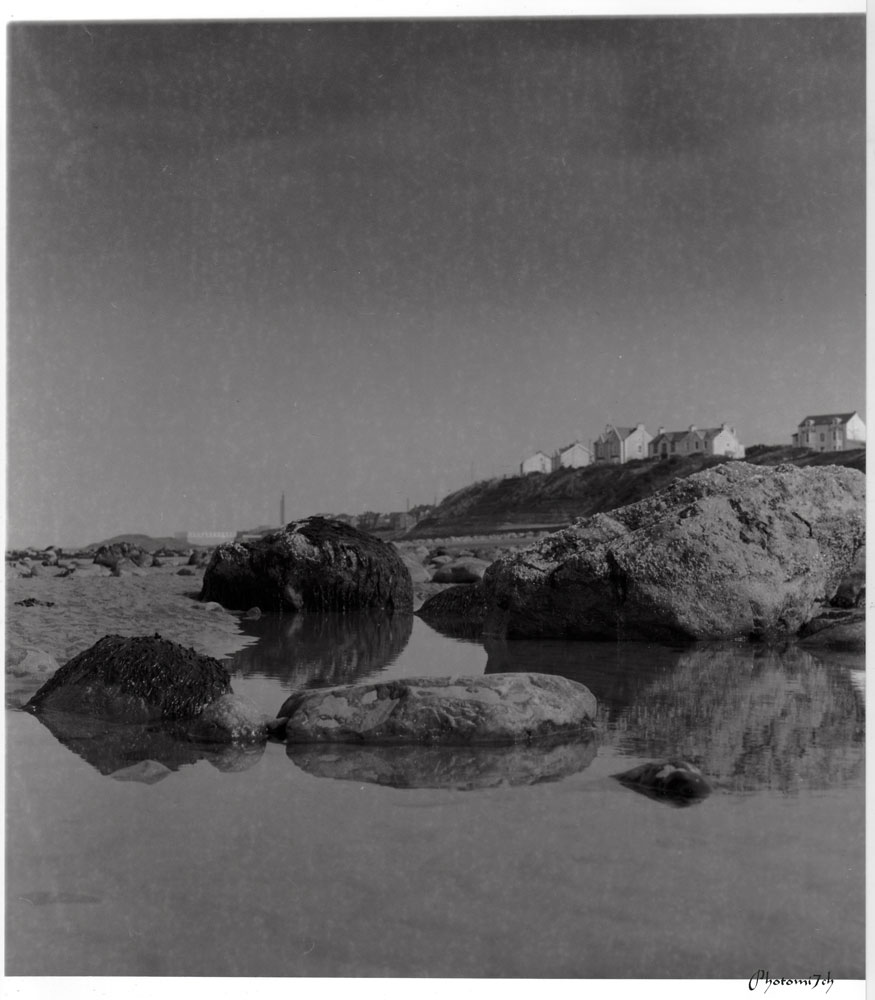
This is not the first time I have mentioned sharpness when it comes to pinhole photography. I know! not something you associate with the dream like quality of the images it produces. It is part of the reason that draws me to using a pinhole camera but it does not stop me speculating whether a T grain film would enhance the detail and therefore increase the sharpness.


I have already informally checked out the idea that Rodinal/RO9 could go some way to increasing sharpness which was done some time ago. (if your interested in that article I'll post a link at the end) The results did confirm that there was something in my observations. I will reiterate that the sharpness increase will not rival that of a lensed camera.


Delta 100 @100iso developed in RO9
 I did find that PMK Pyro developed negatives, when printed looked softer to the pictures produced from negatives processed in Rodinal/RO9 in a very subtle way. This then lead me on to thinking would T grain film with it's enhanced sharpness show a difference when used with a pinhole camera. Better still would it get a double boost when combined with Rodinal/RO9 developer?

 
Contact print on Fotospeed RCVC
So is there a difference? Yes a  noticeable one it has surprised me the level of increase. I'm not sure how much is down to the film alone because the film was developed in Rodinal/RO9. I suspect that most of it is from the films T grain and the developer has just enhanced the equation. 


What do I mean by an increase of sharpness - it shows it's self with a better defining of the details across all areas but still maintains that softness you expect from lens-less images. 


All the above were printed on Fotospeed RCVC paper developed in Ilford multigrade 

Link to older post on sharpness

Saturday, 25 August 2018

Cartier Bresson collected interviews

 This is a wonderful pocket size book that you can dip into anytime. The page colour is not the standard bright white but a gentle off white which is quite resting for the eyes while you read it.

It is laid out in interview/ conversation style, each chapter is a discussion with questions in bold type and answers. Making it easy to put down and pick up without loosing the thread. I have read this book three times in a row it is that interesting.


This is the first time since the interviews were first published that they have been translated from French and put into one book. The book covers twelve interviews from 1951 – 1998. He talks about his passion for books and art about being a prisoner of war, travelling to the far east and setting up Magnum.


I have really enjoyed reading the interviews I was not sure of the format before hand but have discovered you take in far more and analyse what has been said far better than if I had listened.

Published by Aperture.

Friday, 24 August 2018

Zone System really


Love it or hate it Ansel Adams zone system has become the cornerstone of film exposure and printing that a lot of people cannot get their head round. I was one of those people until I made a point of sitting down many years back with a copy of what he actually wrote.

 It is important to stress that when reading his method on the zone system that it comes from the source and that now a days is his volume on the Negative. This is the best place to start your understanding of the process. How do I know this? I read an abridged version of The Camera, The Negative and The Print. To my amazement some of the important parts of the method were left out which made it impossible to understand.


 It was a friends encouragement that I obtain all three volumes and if I did It would improve my understanding of the relationship between the camera and the final print. He was not wrong. I ended up reading all three from cover to cover. I must admit reading the bit on the zone system left me cold. I was none the wiser from this first read. I speculated that I was producing nicely exposed negatives so what was the point.
A year or so later I started to see a number of references to the Zone system on the internet. Some condoning it and other condemning it. This reignited my curiosity in trying to understand it; so I made a loose leaf copy that I carried around with me so I could read it whenever I got the chance and make notes.
I cannot remember how many times I re read it or how many notes I made to remind me what I did not understand and how that fitted in with the rest but all of a sudden it made sense. I could work out how it related to what the light meter was telling me.


It made a difference to the way I metered and exposed the film it also settled down my sometimes erratic results. I noticed that the negatives started to be more consistent in there density which transferred to the darkroom. The number of segmented test prints reduced across a series of images on the same film.

It has been more than a decade since I set out to understand the Zone system. It will always be there in the background of my mind jumping to the fore when I have a particularly difficultly scene to meter. In the main, I use a sort of high bred method that gives me the style of negatives I'm looking for.
All I'm saying is a better understanding of where different tones and textures appear on the tonal scale in relation to the exposure data can only lead to better more consistent results.


Tuesday, 14 August 2018

Be noticed

How often do you review your images before you edit and or print them? There is a well kept secret among film photographers. The photo board or should I say the noticeboard - and yes they do get noticed.

On it I put all my new contact sheets and recently printed images. It is placed across the room from my computer and put there on purpose, allowing me to view the sheets and prints often, in those moments where I need a break from looking at the screen. It is a good reviver and helps to formulate how and which images to print. So when I take the negatives into the darkroom, things run more smoothly. 


I test whether or not the way it is printed and the paper used is right by putting the photograph on the board. Leaving it there for about three weeks or more. It also gives the print time to mature especially if I have used an FB paper. I have found that some of the fainter details show themselves when the print completely dries out. Along with any spotting that maybe needed. If at the end of this time I'm not compelled to reprint it. It becomes a print I'm happy to reproduce for sale.

I also use the noticeboard for editing sets of prints. This is a collaborative thing where anyone can move the order about or remove an image if they do not think it works. When this happens a discussion about the way the story should be told ensues, this a great way of getting the run of the pictures right.

Saturday, 9 June 2018

Out for a stroll with the Zero


It is always a joy to be out with the Pinhole camera. But it must be a strange sight to behold as I walk up the street. A little brown box attached to what could be construed as a big black stick (tripod). On this occasion it was a lovely bright day with a biting cold wind; I had not appreciated just how cold it was until I had been standing about making the first image.


As I strolled around the local lakes I took warmth from the brilliant sunshine and the anticipation of some interesting image making. By the time I was half a dozen pictures in I had forgotten how cold I was. I think the cold must have gotten to me as I could not remember what the reciprocity factor should be. Times 2 up five seconds and times 5 from then on. Dam and I had left my note book behind with the reminders in. Oh well I'm not going back.


from T max negative

This walk is turning to a bit of a jokers holiday which had started before I had even left the house. My Zero is a multi format camera Just before I loaded the film I checked to see where the dividers were and in my mind it was set to 6x6 I loaded the film and used the centre red window to view the frame count. I should explain there are three for the different sizes of negative. Later that day I had the chance to develop the film only to find it was set to 6 x 4.5 – ehh! Fortunately the second film was only part way through so rectified it by using the top window for the next days images.


The wind was that strong it was producing lots of fine ripples across the water. I was not quit sure how this would look in the final images not having made many photos of water with this camera. It just go's to show how cold it was, on the eastern side of the lake I found a lot of glass thick ice being smashed up on the shore. This brought back how cold I was feeling. Time to get back, to a home made slow cooked beef Currie that should be bubbling away by now.


Contact print at 2 seconds
the print is
also showing signs
of exhausted fix.
 
Just before I left the house the following day I filled my pocket with a mix of film from different manufacturers; I do not usually do this but so what! it was an off the cuff decision to go out picture making so why not mix it up completely! The previous day I had already loaded Kodak's T Max 400 which I thought might be a bit of a gamble seeing how bright it was, just as well I did, as I messed up the exposure completely. On subsequent trips I loaded Ilford's delta 100 and Fomapan 100 which is my fav film for the Zero. The others were first time use and this time I got the exposure right.

How badly the T Max was exposed showed it self when I contact printed the negatives. I had to re do it at 5 sec's instead of my usual 2, enlarging lens fully open with white light (with no grade filters set). The negatives when looked at showed full detail. The contact print indicated that the enlargement were going to need long exposures and a lot of dodging to get them the way I wanted.

From Fomapan 100 negative

I have developed all my negatives in Adox version of Rodinal. I use 1+50 for the time required. I have to keep reminding myself that this developer has a high acutance and therefore a lot more contrast. In some cases overly so. I had in mind to use Kentmere RC gloss but changed to Footspeed's RC gloss that has a more normal look. If I had kept to the original route they would have had super contrast. As it was, I had to drop the filtration for printing down to 0 from my normal grade 3 . With the contrast sorted it was time for the exposures. With the segmented test print in the holding tray the fun really started. As an example one print had a base exposure of twenty seconds but then needed an extra 40 seconds on top of that for the sky and some of the lake. Others longer.

From Ilford delta 100 negative.
I had a good time in the darkroom even though the printing sessions were challenging the prints came out a lot better than expected. They have a lot of atmosphere to them that I'm really pleased about. Some of the photographs show that there is ice on the lake in places. I was not sure if that would show up but it has in a couple of the images.