Pages

Wednesday, 23 March 2022

Ansel Adams collection of Portfolios


On one of the many trips in to London many years ago I found myself strolling down Tottenham court road which meant that a detour into Foils Books Store was on the cards before travelling on. It was a warren of floors dedicated to the written word. A discombobulation of a place for those that did not know where their category of interest was held. Fortunately for me this was the umpteenth visit and I knew which floor I needed. Needless to say that getting there was an endeavour in it's self.

Onward and upward to the art/photography department on arrival I stopped momentarily to catch my breath, take in the smell of new books and wonder at the sight. Shelf upon shelf almost to the ceiling of publications standing like solders side by side. Titles like faces undulating along the shelf's as you pass. 

I had just dropped in for a look, I had no particular book in mind it was a destination in its own way, away from the frantic streets outside. A moment to feed the mind. As I looked through the sections I came across The Portfolios of Ansel Adams. “That interesting I thought” and flicked through the pages looked at the price put it back on the shelf and moved on looking at and replacing a number of books. It is interesting to note that all the time I was looking at other volumes my mind kept coming back to the Ansel Adams book it had left an impression.

A short time later I was back in the mix of hurrying people in the street with a bag containing the Adams book. I cannot remember why I was in London, where I went next or if I had my camera with me. The only thing I can be sure of is that a tube ride would have been part of my getting home. With a chance to get a proper good look at my purchase. 

Recently the book is off the shelf and on the coffee table waiting for me to re-antiquate myself with Mr Adams images. I don't know what others do but I like to kick back on the couch with a cup of coffee or tea and spend time with each image studying it in detail. In this case putting the book down at the end of each portfolio to come back to another day.

According to the write up in the book these reproduction are as close as you can get to the original photographs. This I can vouch for having compared images with the same pictures that appear in Ansel Adams 400 photographs book.

Looking back I was fortunate to happen upon the collected portfolios book as I do not think I will see an original and or one of his prints in the flesh. But never say never.


This article is the copyright of Mitch Fusco 2022 all rights reserved.


Wednesday, 9 March 2022

Intermittent visit from the mottle crew bad for negatives


 Up until 2012 I had not experienced any problems with my negatives apart from the problem of water marks. The amount of times prints had been ruined because I had missed one of those dam circles. Life went on, I slowly got the hang of checking for these marks and dust.

Around about the time I started to investigate other developers. Among my group of photographer friends a number of them were talking about PMK Pyro and how it produced super fine negatives with it's staining action. I was told it came in powder form and once made up would last for almost ever.


It became my main developer producing some wonderfully smooth toned negatives and some super smooth prints I was over the moon with the results. That is until a roll of FP4+ produced this mottled affect I was stumped to the cause. The next film I developed was clear of it and so it remained for years. Over time trying a number of different developers along the way without the affect. 

Then all of a sudden three film in a row one FP4+ developed in RO9 and two rolls of Fomapan 100 one in RO9 the other Studional. So it had now't to do with the developer but something common to all three. At the time I traced it to contaminated developing tank and spirals with wetting agent and wrote an article on how I traced it. There will be a link to it at the end. 


The up shot of it was I stopped using wetting agent completely leading to negatives that dry twice as fast and with no water marks. I have been using a soft wet leather to wipe the negatives dry with no ill affects for years. The mottling disappeared as well or did it?

Until recently it is back with a vengeance it has appeared on half a dozen rolls of Fomapan 100. All processed one after the other using HC 110 the difference this time is I know it is not the developer or wetting agent contamination. I was put out only in the sense of its unpredictability I have embraced the mottle as a creative tool and like the affect it has on the photographs produced.

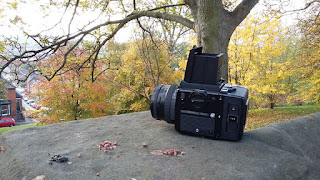
The one bit of information missing so far is that all the affected rolls of film have been 120 format. I went to the film cupboard there was a new unopened pack of 10 Fomapan 100. I opened it and pulled out a roll. Took it out of it's rapper ready to load in the Bronica. What is this? It has the same white silky backing paper as Ilford? Slowly the cogs clanked round.

I still had some from the pack I just processed, what's the best before date? 2018. it would seem you are more likely to get the affect the more out of date the film is. It has also become clear that it is the backing paper casing the mottle. from what I can work out it is the papers expanding and contracting at a different rate to the film base bring into sharp focus how you store the film pointing the finger at big swings in temperature say from fridge to room or freezer to room maybe adding to the increased possibility of it happening. 

On further consideration it maybe also be small amounts of moisture caught between the layers causing the large mottle I have experienced over the years along with the film being out of date. The thing that adds to this idea is the insult of the new Foma backing paper having a hole punched in it leaving a circle on the processed negative.


Once I have used up all my 120 Foma I may not replace it as I cannot trust it not to ruin a good negatives in the future. Which will be a shame as I like to use it with my pinhole camera.

I should not have to add this to the article  the copyright of Mitch Fusco 2022 all rights reserved.


Technical data:

Film I have used that's been affected Ilford FP4+, Fomapan 100, Rollei RPX 400, Agfa 400s. 

All images scanned from photographs.

 It could have been the backing paper all the time and not the wetting agent.  

   Wetting agent contamination link


Wednesday, 23 February 2022

Understanding how to keep Dust at bay.

Have you ever sat and looked at that shaft of light streaming into the room revealing all those microscopic particles dancing in the air. Then blowing in that direction to watch them swirl around. It always makes me think how is it that our lungs do not fur up like that of untouched dust on a flat surface. 

With all those bits hanging around it is a wonder that the film photographer produces any sort of fine-looking photograph. What with having to check and clean inside the back of the camera where the film sits, the camera lens, the film when processed, the enlarging lens, the negative carrier with glass it just wares you out just thinking about it.

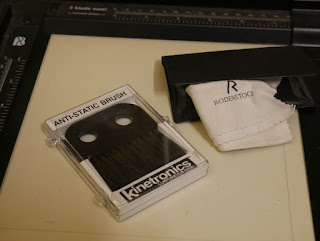
But we don't think about it seriously enough that is why we end up buying all these lens cloths, antistatic brushes, compressed air cans. The amount of time spent on blowing, wiping and brushing only to end up with more dust stuck to our optical surfaces than when we started. It is a wonder that a picture is produced at all.


What is it we need to understand? That the human body is a massive generator of static electricity. We have all experienced at some point walking up to the car and just as we are about to open the door, we get a shock off the car. Wrong you have just shocked the car it is an overload of static in your body grounding itself hence the shock as it leaves you. Yes! You.

The static builds up in us because of the manmade fibers rubbing against our bodies (plastic) acting as an insulator. If you have not earthed yourself, say by washing your hands and or walking around in bare feet. The static continues to build in extreme cases you can get fly away hair. This is where your hair starts to lift up from your head. Before it gets to this point most of us earth ourselves in some way dissipating the static before we get to that shock the car.

Some years ago, I spent a lot of time try to remove some spots of dust from the glass of the negative carrier, having removed it, to have it all come back tenfold as soon as I touched it with my bare hand. The air was blue with my frustration. 

Slowly the penny dropped I was the problem I was magnetizing the glass with the excessive static in my body. Time to sort this once and for all. I had sitting in a draw an earthing band that I used when building a computer. 

The earthing strap was set up by the enlarger where it has remained. It has put in sterling service over the years it's still a wonder, to watch the dust fall off the glass of the negative carrier when I touch it to it. It is also one of the first things I do when entering the darkroom is to touch the earth before I start setting things up. 

Occasionally you get a stubborn particle needing wiping off but nowhere near as much trouble to remove. Once done a touch to earth again making it ready to load the film that is earthed just before loading. 


This article is the copyright of Mitch Fusco 2022 all rights reserved 


Wednesday, 9 February 2022

Street Photography Part 1

 Recently I felt the need to get back to some form normality with a bit of street photography. A return to where I started making photographs all those years ago when I did not realize that the images I was making came under this heading.


Street photography has been around almost as long as the invention of photography One of the early makers of street, although at the time it was properly not known as such, was The Reverend Calvert Jones with a panorama of Santa Lucia, Naples in 1846. 

My need to do this has been fueled by the last three years, in my case with serious illness and then the covid lock downs, restrictions just as I'm well enough to go out. I had become a prisoner of circumstance that really needed to be broken. I also missed being out and about with the camera. Not that I stopped using a camera during lock down.


As camera technology has improved over the centuries and with it the cost of ownership so it has become more popular to the point where everyone has the ability to make street photos but what has not come with it is the understanding of what constitutes a street picture.


A plan was hatched, well! Not really more like an idea about exploring Lincoln's streets and see what images came along in true street photography style. I still needed to choose a camera I thought be bold, Bronica SQAi with 80 mm lens, look down viewfinder and 35mm film back done. Ah! Film?


Street Photograph is the over arching heading that encompasses the man made environment in which the image has been made such as people , portraits, candid, architecture, abstract, transport, still life, minimalist, photo journalist, paparazzo. You do not have to have people as part of the composition as long as the subject projects human involvement.


Those of you who know what a thunder clap the Bronica shutter makes will be thinking it was not a wise choice I did have the same thought. I did say be bold, as it turns out it has made no difference so far. I have made a couple of pictures of people standing very close to them and had no reaction to the shutter thundering shut. I have considered that photographers over play how loud they think the shutter is. 


The places we live, the way we get around them and what we get up to are all part of the scene. You only have to look back at some well know practitioners in recent history such as Saul Leiter, Walker Evans, Berenice Abbot, Lee Friedlander they would include street seen-s devoid of people. In Berenice Abbots case it was mainly the buildings that interested her. If you go back further to Charles Marville in the 1860s he depicted the back streets and allies without people. 


It is good to be out and about meeting people with a smile and a nod as I strolling along the streets looking here and there for images to make. But there is a change an underlying arrogance, a lack of manners of some that insist they cannot wait for you to make an image walking in front of the camera then complain you have them in a image with a snotty look I just smile back. I find this attitude laughable as all of us who walk and or drive round will have been photographed at least 150 times a day by the authorities is OK and yet someone with a camera making images that you maybe a part of get unfounded abuse. 

Maybe at this point I should share some advice on what kit and how to go about making pictures. That is not really me I do not tell people how to be creative we are all different and therefore should approach street from your point of view. There is no special kit you should use apart from what you already have. What I will say is have an open mind to what maybe possible, a good set of walking boots are a must, after a few hours of walking about you will wish you had, use the bear minimum of kit again the same applies even though the camera and meter spend most there time in my hands I find that my shoulder can ache from carrying a camera bag that has little in it apart from some extra film and lens cleaning kit.

This is the first part of a number of articles that will be posted.

If you would like to read more this link will take you there Street P2 Street P3

Images in order of appearance:

  1. Bronica SQAi with 80 mm lens enjoying the view over Lincoln.
  2. Panorama of Santa Lucia Naples 1846 The Reverend Calvert Richard Jones.
  3. 4.5.6.7 Placeses in Lincoln  
Technical data: 

Film: 35 mm Kentmere 100 at box speed, developed in HC 110 B for 6 Minutes. 
Photographs printed on Ilford multigrade RC g developed in Multigrade and scanned from print.


This article is the copyright of Mitch Fusco 2022 all rights reserved.


Wednesday, 26 January 2022

A surprise in the post Wows in the darkroom


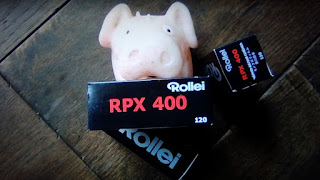
I must admit that Rollei’s 120 RPX 400 was not on my list of film to use. Until, that is, an unexpected package was handed to me by the postman. I usually tend not to use film rated at 400 ISO, as it is usually too fast for the weather I prefer to make images in - bright days with cloud and to a certain extent, warm. 

I did ask a question on the forum (FADU) and was advised that the film can be grainy. With this in mind, my thoughts turned to which developer I should use. HC 110 seems to fit the bill, producing a fine grain and sharp images. The problem with using a new make of film is that any choices you make towards processing are all down to past experience and gut feeling. The Rollei retro and R 3 (the latter no longer made) I have used in the past have always produced some wonderful negatives developed in ID11. What’s different about this one?

With the developer chosen, all I had to do was load the film into my Bronica SQAi with 250 mm lens, set 400 ISO and wait, wait and wait for a break in the weather. It finally did, with some wicked, bright days.


Fortunately I had access to an ancient wood in need of some TLC. The piercing sun presented some great interlaced shadows to play with and a look of dereliction. The four of us spent an hour or so going this way and that looking for interesting shapes, angles, plays of light and dark. A good test of the film’s capability. I tend to take my time lining up an image and, once done, I move on, making each frame count. I know that some people make a back up shot in case the original is damaged in some way. Others bracket above and below the light meter reading they settle on. My counter argument to this is that when using the Bronica SQAi, you only have twelve frames. I accept that I do not always get the light reading spot on with it, which just makes things interesting when printing in the darkroom. Oh! If you are scanning the negs, it won’t matter anyway.

Some days later, the film is loaded in the developing tank and it’s time to process it in HC 110 diluted 1 to 39 for a suggested six minutes. There is always a little apprehension when developing a new film for the first time, wondering if the time will be long enough. As it turned out, there was a nice set of well toned negatives hanging up to dry. Now a bit of impatience sets in while I wait for them to dry - the burning question being how big the grain will be?


24 hours later, the negatives have been cut and sleeved, but not all is well. I have noticed on a number of the negatives that there is a darkened area - something I glimpsed while making one of the pictures. My Bronica 250 mm lens had sustained some damage along the front edge that I should have dealt with by blacking it out. This led to a number of the negatives having a flare of light across them. How bad would be revealed when I print them in the darkroom.


The following is the official line on Rollei RPX 400s capabilities - Panchromatic black and white negative film, 400 ISO with standard development, fine grain and sharpness, broad tonality and contrast range. It is forgiving in that it has a broad latitude of exposure, making it a good choice for push pull development. It’s Panchromatic sensitivity is from 360-660 nm at 2850 k. You will need to bear in mind that this information was sourced after I started the developing process. I tend to do this so I can form my own opinion on what I’m presented with. 


Having removed the cobwebs from the darkroom, it is time to fill the print processor with fresh chemicals and a holding tray with water. The first exposure will be to make a contact print of all the negatives - this will show how many and to what extent the light flare has interfered.

It is disappointing to see that the light damage has touched nearly all the negatives in some way, but never mind - my cropping skills will need to be at their best here. One of the things I have noticed over the years is never to dismiss a set of negatives just because they have not turned out perfectly. It can mean that you produce something more creative than you had in mind in the first place. Serendipity can be a good friend.


Looking at the contact print, it suggested that the negatives could be printed at grade 2 or 3. With further consideration, I opted for grade three because I thought I would get better separation of the tones. To check my decision I would do a second print at grade 2.

I chose to use Ilford multigrade paper and developer - the latter, when fresh, produces some really crisp, rich blacks at the right grade. I set the paper easel to 8 x 10, the enlarging lens to F8 and the filtration to grade 3. With the negative in place, I turned on the test light and used the focus finder to make sure the focus was sharp. Trying to get sharp focus took a bit of time as the grain was very small, much to my amazement.


I always time paper development. It is a way of keeping an eye on how exhausted the developer is becoming. It is obvious, looking at the segmented test print, that the negative is on the thin side and my choice of F8 was a good first step.

As I look at the test print, it is suggesting that 10 to 15 seconds should produce a really good photograph. So I opt for 12 seconds. As I pull the print from the developer ready for the stop, it looks as though I have over exposed. Disappointing maybe, but you should not make quick judgements under red light conditions. 

As I pull the picture from the fix, I turn the room light on. I’m presented with a crisp, high contrast print with some very defined smooth tones. Wow! WOW! It stopped me in my tracks for a bit as I took in the view. Shame about the light pollution, but I can crop that out.


The next print was exposed at grade two for 18 seconds and has a completely different feel to it - again I was impressed. Next, I enlarged the negative to 10 x 20, printing part of it on 8 x 10 paper to see what grain it would produce. None that I could see. 

I have printed a number of the negatives and have been impressed with each of them. I’m not sure why I do not use Rollei film more often. It has a look and feel that I really like - I think some more rolls will be on the cards. Please try this film. You will not be disappointed. 


 This article is the copyright of Mitch Fusco all rights reserved 


Wednesday, 12 January 2022

Bergger Pancro 400 a delightful surprise


I am writing this from the darkroom as I process the second roll of Bergger Pancro 400. It is being developed in Kodak HC 110 for 9 minutes I'm not sure how it is going to turn out as I forgot to soak it for a minute in clean water. I knew something was a miss. It is becoming a joke, nearly every film processed this year, has had a fault one way or another. I will be pleased to get back to the mundane predictability of old. In more ways than one.


Now with the film hanging up to dry I can get back to what I wanted to write. I'm pleased to say that the initial look over the negatives is good in comparison to one I did correctly. I will only know for sure when I start printing.


As you may have already gathered the film needs to be soaked for a minute before the developer go's in. When you pour the water out it has a very slight colour to it. Stop bath is as normal for those that use it but you must fix the film for six mins or longer depending on how old your fix is. Agitation for the developer is for the first 30 seconds (twelve inversions) and then for 5 sec's every 30seconds  ( two inversions.) If you tumble your tank instead of twiddling. When you open the top to pour away the developer there will be bubbles in the top so far I have not noticed any problem with the look of the negatives. 


The lock down has found me time to slow down and consider what I should do. While I mulled things over I did a bit of surfing those were the days now it is just the net for information on macro photography. It became clear that it would be best to use a fast film because of the drop off in light reaching the film plane when using a bellows. I'm in trouble I have no 400 ISO film in 120 while I was surfing down the pipe I came across references to film called Bergger. It did not take long before the screen was swamped with peoples opinion on this film. I scratched the surface to see what was said and looked at the pictures it produced. I was disappointed to find that most of it was scanned negative. One video I watch stated the negatives were flat. I'm pleased I took no notice as the results I have hanging up to dry show otherwise.


I have long held the view that one favourite film developer at a certain dilution should not be a catch all for all makes of film and that a comfort zone is the enemy of creativity and missed opportunity. Manufactures go to great lengths to produce a developer that best brings out the qualities of their film and as I have discovered Bergger is no different only in this case their film has a twin layer of emulsion giving it its full light sensitivity hence the name Pancro. Which would suggest a look all of its own. A comparison of their developer could be on the cards?


For instance I chose to use HC 110 to develop the film, it could quite easily have been Rodinal or one of the half dozen others I have on the shelf but had in mind the fine grain qualities of HC 110. Fast films are not known for there fine grain unless it is a T grain. I should add that the developer you choose has a big influence on the size of grain and the character of the negative and therefore should be given due consideration.

When doing something like this the first time it is a leap of faith that all the information about development is correct. I have found that the time suggested for HC 110 produces a negative that is a little on the thin side for me. It has shown its self in the darkroom with shorter than my usual exposure times. I may increase the development time but for now I'm going to let it stand until I have processed a few more rolls.  

I have exposed a number of rolls of Pancro 400 at box speed. Most of it in high contrast conditions. In some cases with the lens closed down to F 32 at 500th of sec. it has managed to capture a wide range of detail from darkest to brightest. All waiting for you to utilize when exposing it to your chosen paper if you wish. I have found printing these negatives to be some of the easiest. The whites are brilliant and detailed to a degree I have not noticed before with other film. The blacks are rich and pure but can also be very detailed. 


One note of caution it is quite easy to over expose the paper due to the extra tone and crisp detail. I have discovered that I am trying to have it all leading to overly dark and sometimes muddy photographs. With the saying less is more in mind it has lead to some wonderful photographs that are a joy to behold.

You should give Bergger Pancro 400 a go if you have not already done so and print it in the darkroom. Scanning does not do it justice.

A note of caution when using out dated 120 film it can become very grainy even with HC110 when pre soaking, I suggest not doing so to reduce the look of grain.


Technical Data:

All black and white images have been scanned from prints. Contact printed on Ilford MG 5 RC G. Key printed on Kentmere RC G, Containers of fruit printed on Ilford  MG FB, All developed in multigrade. 

The picture of the graduate is used HC 110.    


Thursday, 23 December 2021

Cold tone paper by Ilford with a touch of blue tone developer


When I order new materials for the darkroom I always add something I have not tried before. It can be anything but this time it just so happens it was a box of Ilfords new cooltone FB paper. I was interested to know what their definition of cool was. In my mind it means rich blacks and blueish tones in a very subtle way.


It has taken I bit of time to choose a set of negatives that would give this paper a good workout. Sometime ago I was fortunate to visit the thirty meter high Clydesdale horses heads known as the Kelpies at Falkirk. They are a wondrous sight to see glistening in the landscape. Even more so on the bright cloudless day I visited. Their stainless steel 'coats' sparkled in the sun as you walk round them, making it difficult to look at them without sun glasses. Trying to make photographs that are different is impossible as hundreds of people walk and stand around them taking pictures from every possible angle. It's a snappers paradise! But then every ones experience of these equine giants is different and so are the pictures made.


I used my Bronica 120 6x6 camera to make the pictures I had in mind. Which turned out to be about a dozen frames across two rolls of film. I am not prolific at the best of times but even I was surprised by how few images I had captured.

Armed with two pages of negatives I picked three frames to try this paper out on. I would start by developing the first picture in Ilfords own multigrade print developer this would be the standard to judge the others against. I will also be using my favourite cooltone developer as well.


It is not until you have the photograph in the day light that you can see what the tint of the paper is. It has a very bright white tint to the paper, making the blacks very crisp, but it still has a very subtle warmth to it when compared to Moersch 6 blue tone developer. I know I favour the cold working developer but I also like Ilford rendition of the horses nose, they each have there own character. 

Overall I am very pleased with the way the images have turned out. This paper appears to have a grade more contrast, I think this is due to the very white base colour of the paper compared to the neutral tone paper I am used to. It works well with my favourite blue tone developer. I will have to see if the blue is richer with this paper than others.


Technical data:

Top photograph of the horses head developed in Ilford multigade.

The next one in  Moersch 6 blue.