Pages

Wednesday, 30 December 2015

Oh for the grain.

It is a fact of life for film users, if it was not for the those tiny light sensitive particles we would not have some of the world greatest pictures. All the same overly grainy negatives are a pain if you have not planned for it to happen it's a big let down. You must not forget that it is not all about the journey it is about the results as well and what looks like rubbish to you now. Maybe an inspired choice to others.

The fact you have a negative to look at is a result and something that will print and or scan. At one time grainy pictures were all the rage. Producing some wonderfully expressive images. Admittedly they are not everyone's cup of tea. In other words keep an open mind.


The object of developer is to bring out the latent image held in the emulsion. This is achieved by a chemical reaction, acting on the silver, producing dark areas where it is light and bright areas where there is shadow. The negative is reversed later with the print. There are three important things to keep at the front of your mind are: the development time, the temperature and dilution. It is these three factors that ensure the ultimate image quality when it comes to printing. Too short a development time will produce too thin a negative, like wise too long a process time will make the negative too dense, leading to very short and very long print times respectively.

Agitation is important as well and one of the most over looked parts of the film development, it can in some cases make the difference in how well your negatives turn out. As the developer interacts with the emulsion of the film, it vigorously attacks the silver it comes into contact with and becomes exhausted. By inverting the tank you refresh this action, producing evenly developed negatives. It is important to get this right. To little agitation will allow by-products of the process to build up, leaving pale-toned streamers as they slide to the bottom of the film. Likewise excessive inversions will produce currents in the developer, creating uneven development. Most process times allow for agitation.

Developers:

The first thing to look at is the developer. This has the most influence over how your negatives will look. Before you settle on one in particular make sure you understand its attributes. On a practical note you also need to know how often you will process a film. If you are going to process a film every week or so then it may be better to use one in powder form like ID11 or D76. Or a one shot liquid for occasional use, like Ilfotec HC or Kodak HC110. I have suggested these developers because they are main stream fine grain developers. RO9 is not recognized as a fine grain.

For example:

Ilford ID11: A full speed developer with fine grain. Supplied as a two pack powder. Down side is that you have to make up 5 liters of stock solution. This then leads to question over it's keeping qualities. ( I have taken a year to use a 5ltr batch without any loss of quality) It can be used as one shot or multi use with allowance for depletion. ( I have only ever used as a one shot.)

Ilfords Ilfotec HC: A highly concentrated, fine grain liquid developer. It is suggested that this is the liquid equivalent to ID11.

Kodak D76: Fine grain developer recognized as Kodak's ID11. It has been reformulated as a one pack powder. The down side is that it needs very hot water to mix it easily.

Kodak HC 110: A fine grain sharp working developer. In a highly concentrated liquid syrup form. This is Kodak's answer to ID11/D76 as a liquid.

One more developer to what could be a very long list and that is:

RO9 Special/ Studional. These are the finer bred brothers of RO9 and Rodinal. They are very concentrated liquids with the good keeping qualities you would expect from this family. 

The unexpected.

It is the developer you choose that has the most influence over what your negatives and grain looks like. Inter mixed with the way you apply the agitation method you adopt and making sure that the temperature is right. Master this and the rest will fall into place. Yes you will make mistakes we all do even with years and years of experience it is all part of the rich tapestry of processing. It is and can be a pain when the results effect that special set of negatives. I know, it's that spanner that has landed with a big thud at times. The trick is understanding what went wrong, then put it right and move on. Now a days there is no such thing as a bad set of negatives - just conceptually challenging. You just have to look at all the apps you can get now that put back all things analogue photographers try to avoid. So what maybe unacceptable at first will change over time.

Really what I'm saying is to keep an open mind, the analogue process can, if you embrace it, give an unexpected creative lift to your images. Which today is more acceptable than it used to be. 


Sunday, 27 December 2015

Tetenal Eukobrom AC first look

I like trying new things out in the darkroom, so when an offer to use Tetenal's new monochrome paper developer Eukobrom AC came up I jumped at it. I would like to thank Matt of AG Photographic and Tetenal for the chance to be one of the first to give it a test drive. A few weeks later a package arrived at the door, since then I have been chafing at the bit to try it out.

This is a new developer made for twenty first century. It is also the first commercially to use isoascorbate, vitamin C (you're not seeing things) as the main developing agent, it is a direct replacement for Hydroquinone the most widely used ingredient in photographic developers, noted for it's fast action and high contrast. It is marketed as the alternative to Ilfords multigrade all purpose paper developer producing the same sort of neutral tones. The developer works with both Fiber Baryta and resin coated light sensitive papers, whether multigrade or graded.

Top row: Ilford multigrade RC paper. left side in
multigrade developer. Right side Tetenal.
Bottom row: Fomaspeed variant RC paper. 

The data at the moment is quite sparse.

Technical Data:

Fibre Baryta
Paper (FB)
Dilution
20C
25C
30C
1+4
90s
70s
50s
1+9
100s
80s
60s
Resin coated
paper
1+4
50s
30s
15s
1+9
70s
50s
30s

All information is provided for guidance only. Deviations may arise,
depending upon the paper used. Shortening or extending the development
time by up to 10% is possible.

Diluted 1+9  Eukobrom

In to the Darkroom.

The first thing you notice with this developer is it's lack of odour. The next is the colour of the liquid, a rich yellow. I decided to dilute at 1+9. Once done I poured the contents of the measuring jug into a tray. I would have used my up right paper processor but that already had fresh Ilford multigrade in it. Using the tray for the new developer would allow me to note how long it took for the image to start appearing.

The comparison.

I have several makes of light sensitive paper in stock. I chose three, the most obvious Ilfords multigrade, Fomaspeed Variant 311 and Kentmere VC select gloss, all resin coated papers. I went to these first as they are reasonable quick to process and give an insight into how the Eukobrom will perform. Before moving on to FB papers. (results to follow in another post)

The set up.


I chose a negative from a recently developed set of Agfa APX100. I set the height of the enlarger so it would produce an enlargement of 9 x 12 then set the easel to 8x10. I did this because the Kentmere paper I wanted to include I only had in 9x12, this would keep everything consistent.

Ilford multigrade RC  paper
 developed in Tetenal developer
 
 
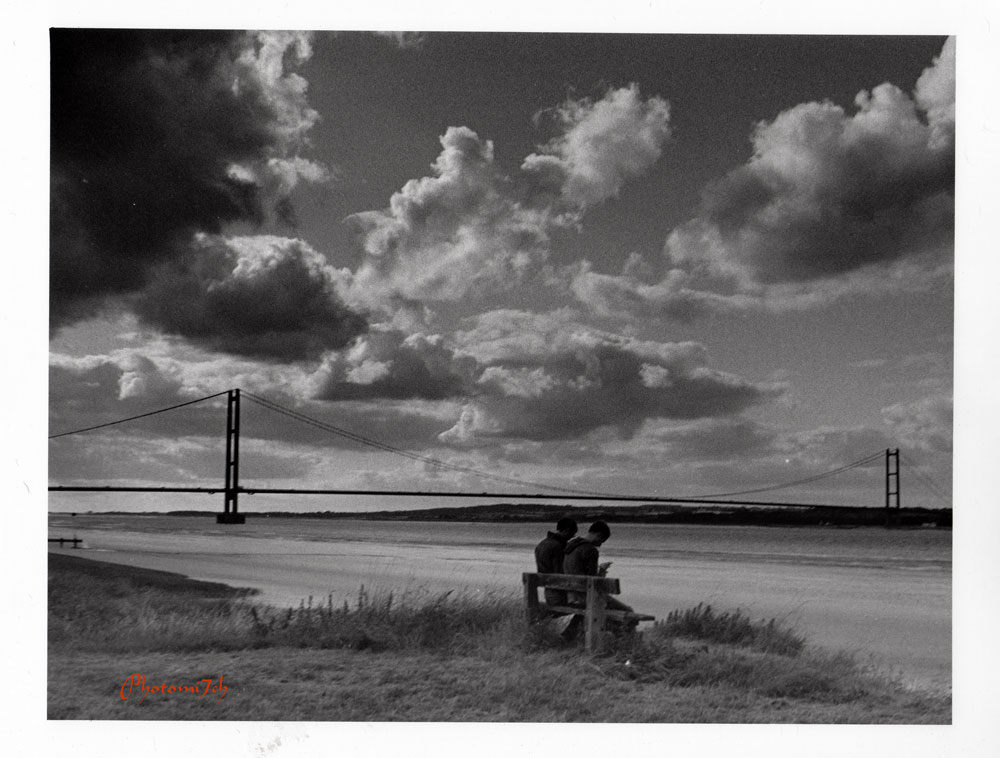
The test strip was processed in the multigrade developer and it was indicating that the image would need to be dodged, if I wanted a picture I was happy with. I set the enlarger as follows lens F8, grade 3, exposure: The whole image was exposed for twelve seconds, the sky from the bridge upwards plus eighteen seconds and finally the sky from half way up to the top of the image plus eighteen seconds. I would produce two pictures on each paper all at the same setting. The developers temperature was set at 20C.


Ilford multigrade RC
 Paper developed in Multigrade
 
Results:

Both developers are advertised as neutral tone. To me this means they are subtlety on the cool side.

The differentiation started with:

  • The Ilford paper when compared with the other papers in the test, has a slight warmth to it's tone when developed in fresh multigrade. The Eukobrom is slightly cooler in look with a more intense black and crisper whites giving it a bit more contrast.
  • The Fomaspeed paper has a cooler look to it when developed in multigrade compared to the Ilford paper. The Eukobrom proved to be cooler looking again with more intense blacks and clearer whites again adding to the contrast.
  • The Kentmere paper is known to have a higher contrast level to the previous papers mentioned maybe as much as a grade. When developed in multigrade the image had a muddy look to it indicating over exposure with a slightly warm feel to it. The Eukobrom processed image had a cleaner crisper look. Again the midtones had better separation making it look more like a moon light picture instead of over exposed.
Fomaspeed variant RC
 developed in Tetenal
 
Once you understand that Eukobrom adds contrast to the image possibly more so than the Hydroquinone it replaces. It is easy to allow for by reducing the grade you would normally use. The blacks are wonderfully rich giving the pictures some real punch. The mid tones have more separation than Ilford multigrade but the surprise is the brightness of the whites.

Fomaspeed  variant RC
developed in Multigrade

Personally the main questions yet to be resolved are its keeping qualities and whether or not the image will be warm when the developer starts to deplete.


Kentmere paper.
Top Row:
exposed at grade three.
Right side Tetenal developer. Left multigrade.
Bottom row: exposed at grade two.
 
This is a nice developer to work with for prolonged periods as you do not get that developer smell lingering up your nose afterwards. Oh! It does look like OJ when diluted so keep it out of the reach of kids. It is a real gem and I will be ordering a bottle, it may even replace my favorite multigrade! Don't take my word for it try it for yourself you will not be disappointed. 


Saturday, 26 December 2015

RO9 special/studional six months from dulition.

Fomapan 200 test negatives.
I'm now six months down the line with this litre of RO9s/Studional and nine completed developments to date. With it now being three months on from it's suggested 'best before' time I started this processing session with the last seven frames from my out of date Fomapan 200, to check that the developer was still viable.

 The Fomapan was in the developer for eight minutes this included the 20% compensation for developers age. For me anyway this developer was now in completely unknown territory and the 20% adjustment was under review again. Although the last time I used the developer the urge to increase was very strong, I considered it again and dismissed the idea very quickly this time. Remembering what I had said last time.


Agfa APX 100 negatives
As soon as the film had been fixed I pulled it out of the developing tank to check. On first look it looked like it had not worked but on closer inspection there was a very good looking negative peering back at me. Great! Now I can get on with the others.

including the 20% and a roll of Fomapan 400 which stopped me in my tracks for a while as I had no suggested development times for it. Ah! What to do? I was processing this for someone else. Don't panic Mr Mannering. I checked through the Massive dev charts 400 ISO film times for Studional with dilutions of 1+15. It was saying that between four and eight minutes. Which is quite a leeway to pair down. I then looked at the Agfa and Rollei times for 400 ISO film to try and shrink the time difference. This helped a lot, it was suggesting five and a half minutes as an average. So me being me rounded it up to six and added 20% which worked out at a bit over seven minutes.

 I intended to develop for seven minutes and ended up doing eight I was interrupted loosing track of the time. It is possible that the mix up has made for a better developed set of negatives which may have worked in my favour this time. Which leaves a dilemma for the next roll - what time should I use?

Fomapan 400 negatives

All in all this out of date developer has proved its self to be a good performer, out of the three newly processed film the Fomapan 200 is disappointing in that the negatives are a bit thin. Some of this is to do with bad exposure and not the development. On closer inspection of this last length of film it looks as though the surface has been contaminated with sweaty finger marks, some scratches and a lot of dust marks on the negatives. Not surprising really seeing that the film has been cut into sections on three other occasions.


It turns out that the Agfa APX 100 has been over developed. I have also noted that the negatives are a bit more grainy than they should be. This could be the down side of using the RO9s outside the three month best before date.


So what now? The developer is good for another three film but I think it will be discarded for a new batch. The reason for using this developer in the first place is because of it's finer grain. If I want it coarse looking I'll use RO9.


Friday, 4 December 2015

Redeveloping the negative.


You will at some point in your developing career, come across a negative(s) that has so much contrast that no matter what you do, you cannot get a decent print. There is a method you can use to retrieve the situation by redeveloping the negative(s).

To start with you will need to make up a solution of halogenizing bleach as follows:

  • 10 grams of Potassium permanganate.
  • 10 grams of Potassium Bromide.
  • 1 litre of cool water.
  • Stir this until all is dissolved in the water.

This can be carried out in a normally lit area so you can see the change in the negative. It takes about 5-7 minutes for the black silver on the film to be converted to a yellowish precipitate. You can remove the film from the bleach when the strongest high lights have gone a pale grey and wash well in running water. Now place in a soft compensating developer. When the highlights return to a greyish yellow remove the film and place in an acid stop bath for 30 seconds. Then fix, wash and dry as you would normally. This should produce a softer easier negative to print.

It is probably better to use a farmers reducer which subtracts the density from a
processed negative.They come ready mixed, you only add the right amount of water. This process can be repeated as many times as needed to get the right density; it's not a one shot approach. Allowing you to do a test print at each stage. There are three to types:

  • Kodak R-4a is best used for over exposed negatives and is easy to control. Acts on shadows first, then mid-range and then highlights. Mainly used for clearing fog from film and reducing prints.
  • Kodak R-4b is best for over developed negatives; it removes equal amounts of deposited silver from the highlight and shadow areas.
  • Kodak R-15 This is a super reducer, striping the highlights and not the shadows. For seriously over developed negatives and is the most difficult to control.

This is just a basic outline on the subject and will require further reading.