Pages

Sunday, 27 December 2015

Tetenal Eukobrom AC first look

I like trying new things out in the darkroom, so when an offer to use Tetenal's new monochrome paper developer Eukobrom AC came up I jumped at it. I would like to thank Matt of AG Photographic and Tetenal for the chance to be one of the first to give it a test drive. A few weeks later a package arrived at the door, since then I have been chafing at the bit to try it out.

This is a new developer made for twenty first century. It is also the first commercially to use isoascorbate, vitamin C (you're not seeing things) as the main developing agent, it is a direct replacement for Hydroquinone the most widely used ingredient in photographic developers, noted for it's fast action and high contrast. It is marketed as the alternative to Ilfords multigrade all purpose paper developer producing the same sort of neutral tones. The developer works with both Fiber Baryta and resin coated light sensitive papers, whether multigrade or graded.

Top row: Ilford multigrade RC paper. left side in
multigrade developer. Right side Tetenal.
Bottom row: Fomaspeed variant RC paper. 

The data at the moment is quite sparse.

Technical Data:

Fibre Baryta
Paper (FB)
Dilution
20C
25C
30C
1+4
90s
70s
50s
1+9
100s
80s
60s
Resin coated
paper
1+4
50s
30s
15s
1+9
70s
50s
30s

All information is provided for guidance only. Deviations may arise,
depending upon the paper used. Shortening or extending the development
time by up to 10% is possible.

Diluted 1+9  Eukobrom

In to the Darkroom.

The first thing you notice with this developer is it's lack of odour. The next is the colour of the liquid, a rich yellow. I decided to dilute at 1+9. Once done I poured the contents of the measuring jug into a tray. I would have used my up right paper processor but that already had fresh Ilford multigrade in it. Using the tray for the new developer would allow me to note how long it took for the image to start appearing.

The comparison.

I have several makes of light sensitive paper in stock. I chose three, the most obvious Ilfords multigrade, Fomaspeed Variant 311 and Kentmere VC select gloss, all resin coated papers. I went to these first as they are reasonable quick to process and give an insight into how the Eukobrom will perform. Before moving on to FB papers. (results to follow in another post)

The set up.


I chose a negative from a recently developed set of Agfa APX100. I set the height of the enlarger so it would produce an enlargement of 9 x 12 then set the easel to 8x10. I did this because the Kentmere paper I wanted to include I only had in 9x12, this would keep everything consistent.
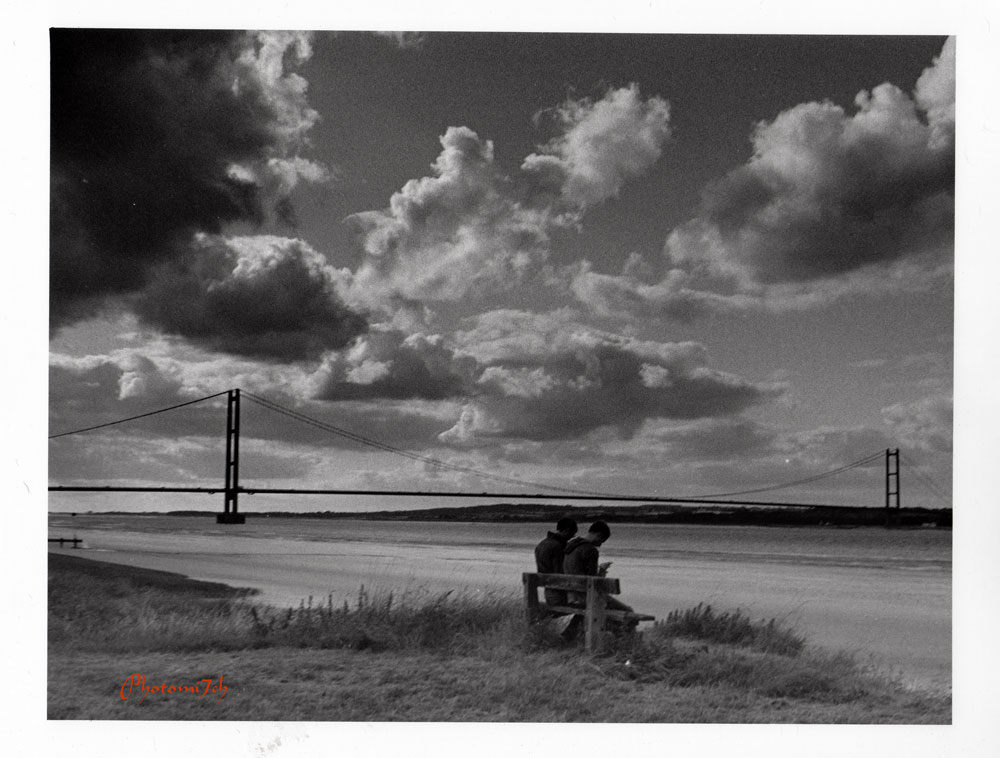
Ilford multigrade RC  paper
 developed in Tetenal developer
 
 
The test strip was processed in the multigrade developer and it was indicating that the image would need to be dodged, if I wanted a picture I was happy with. I set the enlarger as follows lens F8, grade 3, exposure: The whole image was exposed for twelve seconds, the sky from the bridge upwards plus eighteen seconds and finally the sky from half way up to the top of the image plus eighteen seconds. I would produce two pictures on each paper all at the same setting. The developers temperature was set at 20C.


Ilford multigrade RC
 Paper developed in Multigrade
 
Results:

Both developers are advertised as neutral tone. To me this means they are subtlety on the cool side.

The differentiation started with:

  • The Ilford paper when compared with the other papers in the test, has a slight warmth to it's tone when developed in fresh multigrade. The Eukobrom is slightly cooler in look with a more intense black and crisper whites giving it a bit more contrast.
  • The Fomaspeed paper has a cooler look to it when developed in multigrade compared to the Ilford paper. The Eukobrom proved to be cooler looking again with more intense blacks and clearer whites again adding to the contrast.
  • The Kentmere paper is known to have a higher contrast level to the previous papers mentioned maybe as much as a grade. When developed in multigrade the image had a muddy look to it indicating over exposure with a slightly warm feel to it. The Eukobrom processed image had a cleaner crisper look. Again the midtones had better separation making it look more like a moon light picture instead of over exposed.
Fomaspeed variant RC
 developed in Tetenal
 
Once you understand that Eukobrom adds contrast to the image possibly more so than the Hydroquinone it replaces. It is easy to allow for by reducing the grade you would normally use. The blacks are wonderfully rich giving the pictures some real punch. The mid tones have more separation than Ilford multigrade but the surprise is the brightness of the whites.

Fomaspeed  variant RC
developed in Multigrade

Personally the main questions yet to be resolved are its keeping qualities and whether or not the image will be warm when the developer starts to deplete.


Kentmere paper.
Top Row:
exposed at grade three.
Right side Tetenal developer. Left multigrade.
Bottom row: exposed at grade two.
 
This is a nice developer to work with for prolonged periods as you do not get that developer smell lingering up your nose afterwards. Oh! It does look like OJ when diluted so keep it out of the reach of kids. It is a real gem and I will be ordering a bottle, it may even replace my favorite multigrade! Don't take my word for it try it for yourself you will not be disappointed. 


Saturday, 26 December 2015

RO9 special/studional six months from dulition.

Fomapan 200 test negatives.
I'm now six months down the line with this litre of RO9s/Studional and nine completed developments to date. With it now being three months on from it's suggested 'best before' time I started this processing session with the last seven frames from my out of date Fomapan 200, to check that the developer was still viable.

 The Fomapan was in the developer for eight minutes this included the 20% compensation for developers age. For me anyway this developer was now in completely unknown territory and the 20% adjustment was under review again. Although the last time I used the developer the urge to increase was very strong, I considered it again and dismissed the idea very quickly this time. Remembering what I had said last time.


Agfa APX 100 negatives
As soon as the film had been fixed I pulled it out of the developing tank to check. On first look it looked like it had not worked but on closer inspection there was a very good looking negative peering back at me. Great! Now I can get on with the others.

including the 20% and a roll of Fomapan 400 which stopped me in my tracks for a while as I had no suggested development times for it. Ah! What to do? I was processing this for someone else. Don't panic Mr Mannering. I checked through the Massive dev charts 400 ISO film times for Studional with dilutions of 1+15. It was saying that between four and eight minutes. Which is quite a leeway to pair down. I then looked at the Agfa and Rollei times for 400 ISO film to try and shrink the time difference. This helped a lot, it was suggesting five and a half minutes as an average. So me being me rounded it up to six and added 20% which worked out at a bit over seven minutes.

 I intended to develop for seven minutes and ended up doing eight I was interrupted loosing track of the time. It is possible that the mix up has made for a better developed set of negatives which may have worked in my favour this time. Which leaves a dilemma for the next roll - what time should I use?

Fomapan 400 negatives

All in all this out of date developer has proved its self to be a good performer, out of the three newly processed film the Fomapan 200 is disappointing in that the negatives are a bit thin. Some of this is to do with bad exposure and not the development. On closer inspection of this last length of film it looks as though the surface has been contaminated with sweaty finger marks, some scratches and a lot of dust marks on the negatives. Not surprising really seeing that the film has been cut into sections on three other occasions.


It turns out that the Agfa APX 100 has been over developed. I have also noted that the negatives are a bit more grainy than they should be. This could be the down side of using the RO9s outside the three month best before date.


So what now? The developer is good for another three film but I think it will be discarded for a new batch. The reason for using this developer in the first place is because of it's finer grain. If I want it coarse looking I'll use RO9.


Friday, 4 December 2015

Redeveloping the negative.


You will at some point in your developing career, come across a negative(s) that has so much contrast that no matter what you do, you cannot get a decent print. There is a method you can use to retrieve the situation by redeveloping the negative(s).

To start with you will need to make up a solution of halogenizing bleach as follows:

  • 10 grams of Potassium permanganate.
  • 10 grams of Potassium Bromide.
  • 1 litre of cool water.
  • Stir this until all is dissolved in the water.

This can be carried out in a normally lit area so you can see the change in the negative. It takes about 5-7 minutes for the black silver on the film to be converted to a yellowish precipitate. You can remove the film from the bleach when the strongest high lights have gone a pale grey and wash well in running water. Now place in a soft compensating developer. When the highlights return to a greyish yellow remove the film and place in an acid stop bath for 30 seconds. Then fix, wash and dry as you would normally. This should produce a softer easier negative to print.

It is probably better to use a farmers reducer which subtracts the density from a
processed negative.They come ready mixed, you only add the right amount of water. This process can be repeated as many times as needed to get the right density; it's not a one shot approach. Allowing you to do a test print at each stage. There are three to types:

  • Kodak R-4a is best used for over exposed negatives and is easy to control. Acts on shadows first, then mid-range and then highlights. Mainly used for clearing fog from film and reducing prints.
  • Kodak R-4b is best for over developed negatives; it removes equal amounts of deposited silver from the highlight and shadow areas.
  • Kodak R-15 This is a super reducer, striping the highlights and not the shadows. For seriously over developed negatives and is the most difficult to control.

This is just a basic outline on the subject and will require further reading.

Saturday, 14 November 2015

RO9 and the lens less camera.

All the photo's side by side
Over the last few months it looks like I have gone RO9s mad. I have! it is the new toy in my developing arsenal. I'm enjoying the quality of the negatives and not having to make up developer every time I want to process a film. It is still new enough for me to think I have forgotten to do something as I pour the liquid in the developing tank. With all this effort being spent on this developer it has made me think about its brother RO9 and it's attributes in connection with pinhole photography.

Image from PMK Pyro developed negative printed
on Ilford multi grade RC gloss.
Let me explain: RO9 is described as having a number of qualities, the main one here being, high acutance producing a very sharp looking image - a bit like sharpening a digital file in Photoshop. The idea that this developer may do this to the processed negatives has been a splinter in my mind for sometime, that I have been compelled to dust off my Zero pinhole camera to find out if it does make a difference.


Image from RO9 developed negative.
Printed on Kentmere RC gloss
I always feel very relaxed after I have spent time making images with this camera, I should use it more often. Anyway I loaded it with Fomapan 100 set to a 6x6 negative size.

 With the twelve images made it was into the darkroom to process the film. It was developed in the RO9 for thirteen minutes. The density of the negatives was as expected. With the new crisp looking negatives hanging up to dry what should I compare them with? After searching back in my archive of negatives it looks like the only other developer I have used when making images with the Zero is PMK Pyro. This developer is not known for it's sharpness but at least I did not follow the method through by using an afterbath. Which can add a further softening of the image by adding tone.

Zero pinhole set to 6x6 120 negative size

My comparison was never going to be very scientific. It was always going to be a case of would I be able to see a difference with the naked eye. You may feel that the comparison is unfair and to a certain extent you are right. To counter this I will compare the RO9 negatives with those produced with a lensed camera. If the RO9 is a sharpening developer it should be noticeable.


Image made using a camera lens.
35 mm Agfa APX 100 developed ID11

When looking down the focus finder at the different developed negatives the difference in grain structure jumps out at you. The PMK Pyro neg's are so smooth it is difficult to bring the the grain into sharp focus. Where as the RO9 grain looks like boulders. So does this defined structure indicate that the negatives will be sharper?

I enlarged the negatives to fill the 9 x 12 Kentmere RC gloss paper, instead of the smaller 6X6 square format of the negative. I wanted to see if the grain would be more exaggerated by doing this. To my surprise they lack the graininess I was expecting. In fact they are very smooth and defined.

RO9 developed negative printed
on Kentmere RC gloss
Conclusion:

With all the photographs laid out side by side is there a visual difference in sharpness? The straight answer is Yes but not enough to say if you want sharper lens-less images use Ro9. When you compare the PMK negatives with the RO9 ones there is slightly better definition to the edges of the subject giving you the sense that the pictures are sharper. It does not take away that distinct soft focus you get with pinhole cameras. If you then put a lensed print beside the RO9 developed picture you can see that it is very soft in the pinhole tradition. It shows that when using RO9 there is a sharpened quality to the photographs.


PMK Pyro developed image printed on Fomaspeed
Variant 131


Monday, 9 November 2015

Instant Photographs.

When I heard about the demise of Polaroid. I was saddened, to think that at one time I had a Polaroid camera in my car all the the time, along with a dozen packs of film (the peal apart type). In those days if I only made 50 images in a week I classed it as a slow period. With Polaroids announcement I had the sudden urge to make a few pictures before it disappeared. Sadly I could not find my camera, then remembered that I had given it away.  

About ten or so years ago we acquired an Instax 200 instant camera that has sat in my camera cupboard. It would still be sitting there gathering dust if it had not been for a marketing email from Lomography stating the camera and film were available again.

Some weeks later I was in town, so I dodged into my local Snappy snaps to see if they had the film in stock. They did, so I purchased a box - not a cheap venture now a days!

The camera has been boxed all this time and is brand new to look at apart from a broken battery cover. To my surprise there was still a film in it. I put batteries in it, took a picture and out popped an oblong card. Then waited to see if an image would appear, Alas after a good five minutes just a slight change in colour. It was worth a try.


It was some months before I had the opportunity to use the new film in the camera. Then fortune smiled and what a cracking day it was. At the time, it was a leap in the dark as I have never used this camera before. I lost a couple of frames to bad composition and to under development which can be adjusted in the camera settings. It did not take long to catch on. As you can see from the pictures.


The panoramic view the cameras produces has a distinct look to them.


Friday, 23 October 2015

RO9 special/ Studional three months on.

Out of date Fomapan 200
Another month on and I'm back to using the turquoise Studional and a further cutting from the Fomapan 200, only this time there are couple of dozen images to muck up. The chances of something going wrong diminishes as you get used to the way the developer works, the only spanners are out of date film and senior moments, if it all go's wrong I may learn my lesson.


Out of date Fomapan 200
So far the developer has been used seven times without it missing a step. When comparing the negatives with the naked eye or in this case a magnifier the density between the batches looks to be identical. As far as the compensation factor is concerned this is uncharted territory for me. The question is, does 20% allowance still apply two months on? Thinking on it carefully the answer is yes. My reasoning is that to increase it without knowing whether the suggested compensation worked or not does not make sense. I should test the information and not do my own thing.
 

The information on this developer states that once it is diluted one litre should be good for three months or 12 film processes which ever you arrive at first if stored properly. I will admit that the bottle this is stored in is to big leaving an air gap that will allow the developer to deteriorate more quickly according to the data sheet. I have not done this on purpose I didn't have a container the right size and yet it still works well. Obviously it is better to do what manufacturer recommends to get the best results but in the real world we all make compromises. So is it such a surprise that I'm getting good results? The real test will be at four, five or six months after dilution.


Out of date Fomapan 200
 I processed the negatives as previously mentioned and the results are just as good so much so that I also developed a roll of Agfa APX 100. It just so happens that the dilution for this film is 1+15 (the same as HP5+) or 1+31 for 4 and 8 minutes respectively at 100 ISO. With the 20% adjustment added it took all of five minutes in the developer to receive another set of good looking negatives.


The more I use this developer the more impressed I am with it.


 The table below shows ten popular film that use the 1 +15 dilution. The ones marked with * are the ones I have had good results with at the suggested times with the compensation added.

The double ** is my suggested time for this film at this dilution.


Dilution of 1+15


Film
ASA/ISO
TIME
Adox CHM125
100
3.5
Agfa APX 100 *
100
4
Fomapan
100
10
Fomapan **
200
6
FP4+ *
125
4
HP5+ *
400
4
Neopan
400
6
PAN F+
50
3
Rollei Retro S
400
8.5
Tri-X
400
05/03/05

All the images that appear in this post were Developed in RO9 special
Studional.

This image is from the Agfa APX 100 film mentioned.


Saturday, 17 October 2015

Black developer!?

I have gone back to using 35mm film, in so doing I have resurrected an old and long running project of portraits. I have never been backward in coming forward to ask people I meet if I can take their picture. When asking my chosen subject I'm polite and friendly with a little charm. It is not often that I receive a straight rejection. I've noticed that it tends to stop people for a moment, at which point I tell them it's a film camera. It appears that this is a reason for them to say yes when chatting with them.

This new interest in lugging my Nikon F5 around with me has also reunited me with a long time favorite film Agfa APX 100. I cannot remember exactly the last time I used this film but I do know it was back in the days when I regularly used ether ID11 or PMK Pyro. I still have both these developers on the shelf in powder form. Which led to a bit of a  dilemma once the new roll of
APX was ready for developing. Should I make up a new batch of these old friends to keep the look of the negatives the same or go with the current ones???.
                                                        

I chose to go with RO9 partly because I wanted to see what sort of negative it would produce with the APX.                                                                      
Agfa APX  negatives developed with
RO9 special.
Before starting I made up a litre of fresh stop, fix and 300 mls of developer. I processed the film for the suggested thirteen minutes. The time counted down, as I poured out the developer, I was shocked to see this black liquid fill the measuring cylinder what the Hell! My first thought was that all the emulsion had come off, stupid I know but it always interests me what thoughts come into your head when things take you unaware. Needless to say that when I looked at the negs after they were fixed, all was OK. The negatives are nicely toned. I am not sure yet how grainy they are as Ro9 tend to be more grain than ID11.


It's just another colour to add to an increasing list of used developers.